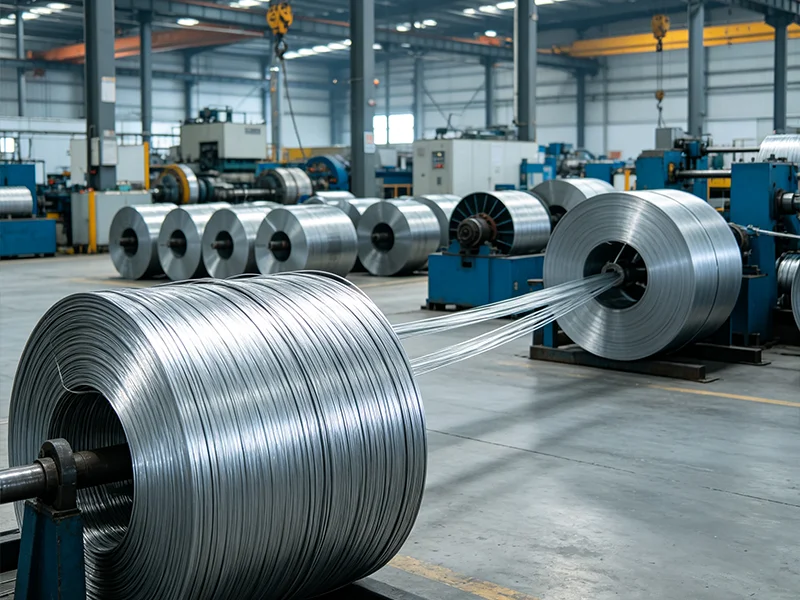
Wire mesh and screen wire refer to a woven or welded grid of metal wires that forms uniform openings for filtration, separation, screening, and protection applications. These products are manufactured from various metals and alloys, with precise control over wire diameter, mesh count, opening size, and weave pattern. Industries such as chemical processing, pharmaceuticals, food and beverage, mining, agriculture, construction, and water treatment rely on wire mesh and screen wire for consistent performance under demanding conditions.
Luguan produces wire mesh and screen wires in a wide range of specifications, from coarse heavy-duty screens for aggregate separation to ultra-fine meshes used in medical filtration. Each batch is tested for dimensional accuracy, tensile strength, and surface finish to meet international standards such as ASTM, ISO, GB, DIN, and JIS.
Weave Type Comparison Table
|
Weave Type
|
Description
|
Typical Use
|
Available Mesh Range
|
|
Plain weave
|
Each warp wire passes over one weft wire and under the next, creating a square opening and stable structure.
|
General screening, sieving, partitions, and protective guards.
|
2 mesh to 400 mesh
|
|
Twill weave
|
Each warp wire passes over two weft wires and under two, allowing heavier wire diameters for the same mesh count.
|
High-strength filtration, vibrating screens, and architectural mesh.
|
10 mesh to 635 mesh
|
|
Plain Dutch weave
|
Warp wires are larger in diameter than weft wires, producing a dense, strong cloth with very small passage channels.
|
Hydraulic filtration, fuel filters, and high-pressure liquid-gas separation.
|
12 mesh to 400 mesh
|
|
Twill Dutch weave
|
Similar to plain Dutch weave but with a twill pattern, enabling even finer filtration and improved flow characteristics.
|
Ultra-fine polymer filtration, chemical processing, and catalyst recovery.
|
20 mesh to 500 mesh
|
|
Reverse Dutch weave
|
Weft wires are larger than warp wires, creating a smooth surface with high strength against abrasion.
|
Heavy-duty liquid filtration and solid-liquid separation in mining.
|
20 mesh to 200 mesh
|
Material Selection
Luguan supplies wire mesh and screen wires in multiple materials to match chemical compatibility, temperature exposure, and mechanical load requirements. The choice of material directly affects corrosion resistance, service life, and total cost of ownership.
-
Stainless Steel 304: The most common alloy for general filtration and screening. It offers good corrosion resistance in mild chemical and atmospheric environments.
-
Stainless Steel 316 and 316L: Contains molybdenum for improved resistance to chlorides, acids, and saltwater. Suitable for marine, pharmaceutical, and food processing applications.
-
Galvanized Steel: Low-cost option for construction, agriculture, and temporary screening. The zinc coating provides moderate corrosion protection.
-
Black Steel: Plain carbon steel without coating. Often used for internal structural support or where painting will be applied.
-
Brass and Copper: Non-magnetic, electrically conductive, and resistant to certain chemicals. Used in decorative screens, RF shielding, and marine filters.
-
Nickel, Monel, and Inconel: High-performance alloys for aggressive chemical environments, elevated temperatures, and critical aerospace or nuclear applications.
-
Aluminum: Lightweight and corrosion-resistant, suitable for window screens, insect screens, and ventilation panels.
Manufacturing Process and Quality Control at Luguan
Luguan controls every step of wire mesh and screen wires production, from raw material inspection to final packaging. The manufacturing process begins with premium-grade wire rod that is drawn to the exact diameter specified by the customer. Computer-controlled looms weave the wire into mesh with consistent tension and alignment. After weaving, the mesh passes through in-line inspection stations that use laser measurement to verify opening size and wire diameter at multiple points across the roll width.
Post-processing operations include pickling and passivation for stainless steel, hot-dip galvanizing for carbon steel, and optional PVC or epoxy coating for enhanced corrosion resistance and color customization. Rolls can be cut to length or fabricated into discs, circles, rectangles, and three-dimensional filter elements. Every production lot receives a certificate of conformance that documents the mesh count, wire diameter, opening size, material grade, and applicable standard.
Frequently Asked Questions About Wire Mesh And Screen Wire
Q1: What is the difference between wire mesh and screen wire?
Wire mesh generally refers to any woven or welded metal grid with defined openings, used for filtration, separation, reinforcement, or protection. Screen wire is a subset of wire mesh that is specifically designed for screening and sizing operations, such as separating particles by size or preventing the passage of unwanted materials. In practical terms, the two terms are often used interchangeably. At Luguan, screen wire usually implies a product optimized for vibrating screens, trommels, or stationary sieves, with tighter tolerances on opening dimensions and higher wear resistance.
Q2: How do I choose the right mesh count for my application?
Mesh count should be selected based on the particle size you need to retain or pass, the required open area for flow, and the mechanical load the mesh must withstand. Start by determining the maximum particle size that must pass through the screen. Then calculate the opening size needed and convert it to the closest mesh count using a standard conversion chart. For filtration applications, a finer mesh count increases particle retention but reduces flow rate, so you may need a larger filter area to compensate. Luguan engineers can help you select the right balance between mesh count, wire diameter, and open area for your specific process conditions.
Q3: What materials are available at Luguan?
Luguan offers stainless steel grades 304, 304L, 316, 316L, 321, and 430, as well as galvanized steel, black steel, brass, copper, phosphor bronze, aluminum, nickel, Monel, Inconel, Hastelloy, and titanium. The material choice depends on the operating environment. For acidic or chloride-containing media, 316L or Inconel is recommended. For food contact, 304 or 316 with a passivated surface is typical. For high temperatures above 800°C, nickel-based alloys or special stainless grades may be required. Each material can be supplied with mill test certificates and full traceability.
Q4: Can Luguan provide custom roll sizes and cut-to-size pieces?
Yes. Luguan supplies standard rolls in widths from 0.6 m to 2.0 m and lengths from 15 m to 100 m, but custom widths up to 3.0 m and custom lengths are available upon request. In addition to full rolls, we provide cut-to-size sheets, discs, circles, rectangles, and fabricated filter elements. Customers can specify exact dimensions, edge treatment, and packaging requirements. Laser cutting, shearing, and ultrasonic cleaning services are also available for precision components used in medical, semiconductor, and aerospace industries.
Q5: How is wire mesh packaged for shipping?
Wire mesh and screen wires from Luguan are packaged to prevent damage during transit and storage. Rolls are wrapped in moisture-resistant paper or VCI film, then covered with plastic sheeting. The rolls are placed horizontally inside wooden crates or on export-grade pallets with edge protectors. For fine mesh below 100 mesh, additional foam layers and rigid cores prevent deformation. Each package is labeled with the product code, mesh count, roll number, and gross weight. Custom packaging such as vacuum sealing or individual cartons is available for high-value or cleanroom applications.